Peptide Treatment Cost: What You Pay and Why It Varies
What drives the cost of peptide treatment in the US: peptide, dose, labs, physician oversight and course length. Learn what a quote should include.

Peptide treatment cost in the United States has no single price. A protocol can run from the low hundreds to well over a thousand dollars a month, and the gap comes from five things: which peptide you are prescribed, the dose and form, how long you stay on it, the labs and follow-up around it, and whether a physician is actually supervising. The useful question is not “what is the cheapest vial?” but “what does this quote include, and who is accountable if my labs or symptoms change?” This guide shows you how to read a quote, what to expect on top of the medication, and how the 2026 changes in federal compounding policy affect what you are being sold.
At Strong Health, every protocol is prescribed and monitored by a board-certified physician after an in-person or telehealth evaluation and baseline labs. We do not publish a fixed price for protocols on our site, because the plan is built around your labs and your goal. That is the same reason prices elsewhere are so hard to compare.
TL;DR
- Peptide therapy is paid out of pocket for most people, and monthly costs vary widely by peptide, dose, delivery form and the clinic’s level of oversight.
- A fair quote separates the evaluation, baseline labs, the medication itself, supplies and follow-up. A single low monthly number that leaves these out is not comparable to a full protocol.
- Course length changes the total more than the monthly price: ask how many months the plan assumes and how it is reassessed.
- Insurance rarely covers compounded peptides. Medicare covers certain approved weight loss drugs under a temporary program, which is a different category.
- In late 2026, federal policy on compounding certain peptides is in flux, so confirm a clinic’s sourcing and prescribing process before you pay.
Table of Contents
- Why there is no one price for peptide therapy
- What a complete quote should include
- Monthly cost versus the cost of a full course
- Does insurance cover peptide therapy?
- What changed in 2026 and why it affects price
- How cost differs by goal
- Safety checks that belong in any price conversation
- Getting your own number
- FAQ
- Sources
Why there is no one price for peptide therapy
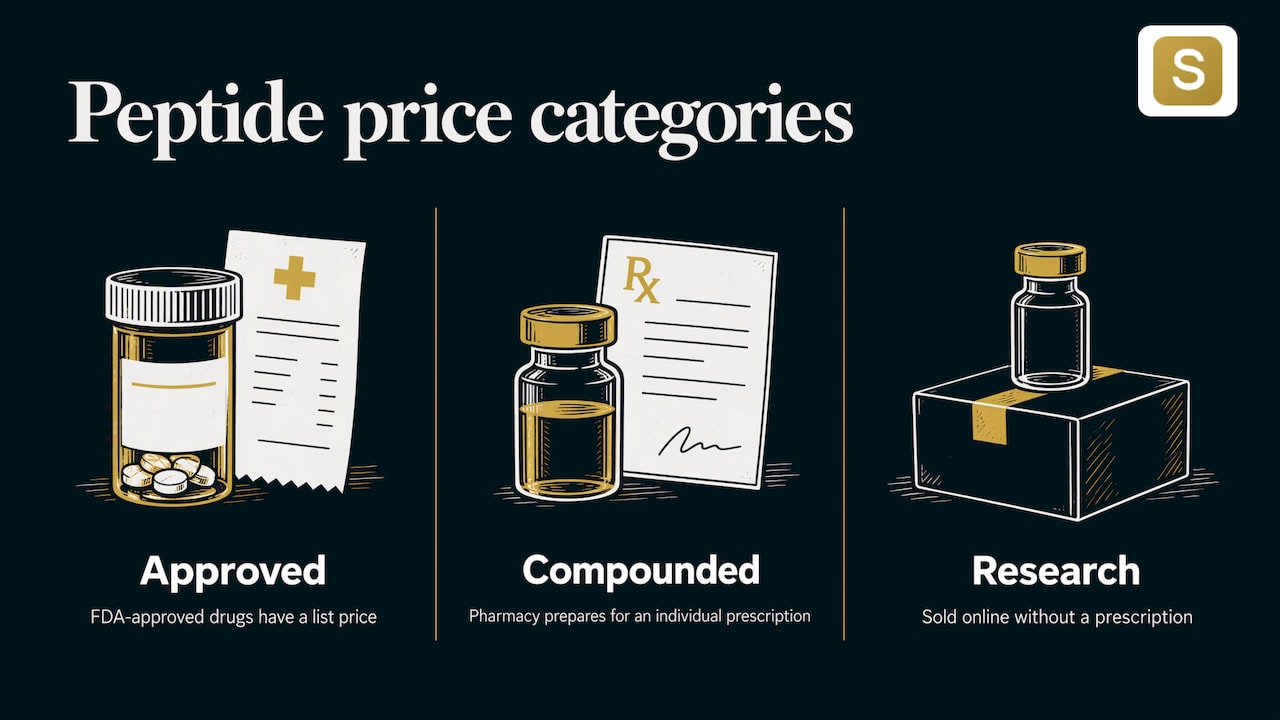
Peptides are short chains of amino acids. Some are FDA-approved drugs with a list price, such as semaglutide in Wegovy. Others are compounded: a licensed pharmacy prepares them for an individual patient on a physician’s prescription. Others still are sold online as “research chemicals” with no prescription at all. Those three groups sit in completely different price tiers, and many cost guides blend them into one average.
That is why published ranges are so wide. Clinic and telehealth pages quote anything from under $100 to more than $1,000 a month, and each number reflects a different mix of peptides and services. Because those pages are written by businesses selling the therapy, treat any single figure as a marketing anchor, not a benchmark. The reliable way to know your cost is a written quote for your own protocol.
Here is what moves the number.
The peptide itself
A peptide for tissue repair, one for sleep, one for growth hormone support and one for weight management are different molecules, made in different quantities, with different supply chains. Approved brand-name drugs generally cost far more at retail than compounded alternatives, but the compounded route carries regulatory questions covered below. Price per month also depends on how many peptides your plan uses. A single-peptide protocol costs less than a plan with two or three.
Dose, form and frequency
An injection taken daily uses more product than one taken a few times a week. Nasal sprays, oral forms and topical products are priced differently from injectables. Dose is set by your physician and often changes as your labs and response change, so a month-one price may not stay fixed through the whole course.
Level of medical supervision
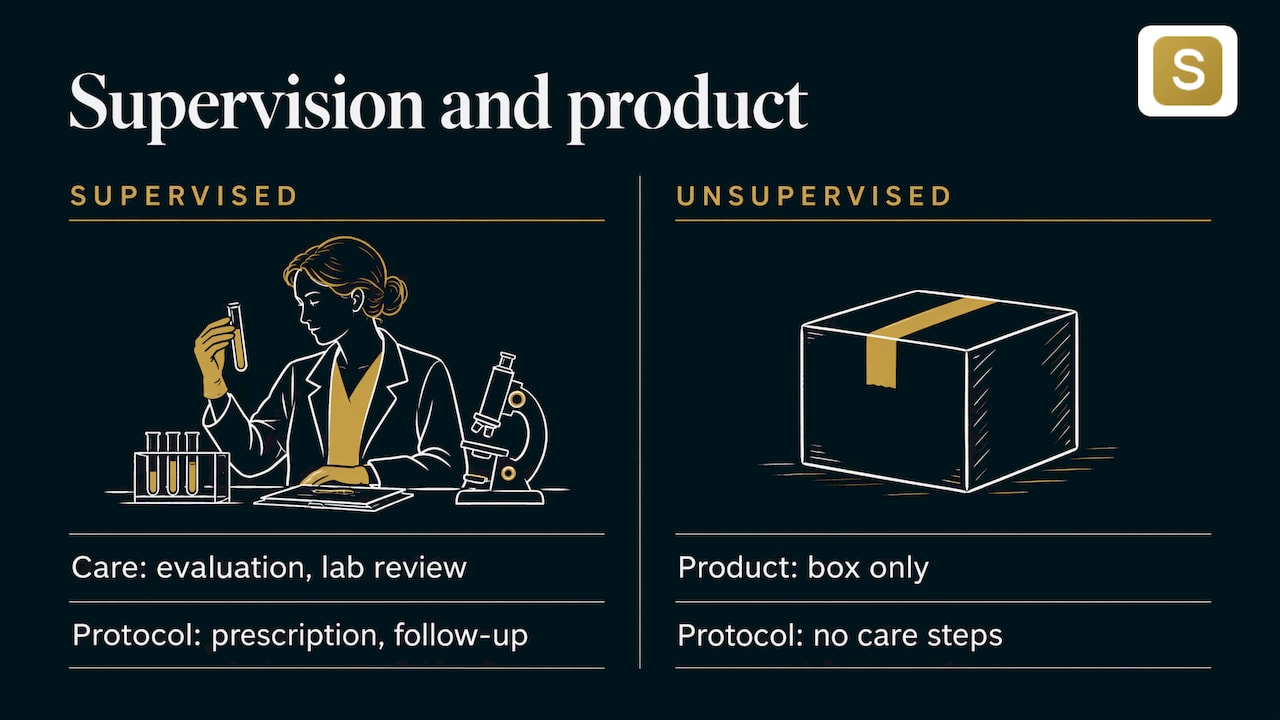
This is the hardest factor to see in a price list and the one that matters most for safety. A supervised protocol includes an evaluation, a prescription decision, lab review and follow-up. An unsupervised product includes a box. When one price is half of another, ask which of these steps is missing.
Labs and diagnostics
A responsible clinic runs baseline labs before prescribing so that the peptide matches a measured need rather than a guess. Depending on your goal, that can mean hormone testing and other biomarker panels, and sometimes imaging or body composition work. At Strong Health, diagnostics such as DEXA scans, hormone testing, VO2 max testing and RMR testing are available alongside peptide care, which lets your plan start from your own numbers.
Length of the course
Most cost shopping happens at the monthly level, but you pay for the whole course. We cover that next.
What a complete quote should include
When you compare providers, ask for the same line items from each. A transparent quote lists:
- The evaluation. Is the first visit in person or by telehealth, and is it a separate fee or bundled?
- Baseline labs. Which panels, who draws them, and whether they are included or billed separately.
- The medication. Which peptide, what form (injection, nasal, oral, topical), what dose range, and how many weeks the first supply covers.
- Supplies. Syringes, needles, alcohol swabs and sharps disposal, if you inject.
- Follow-up. How often you are reassessed, whether visits are included, and whether repeat labs are part of the plan.
- Dose adjustments. Whether changing your dose triggers a new fee.
- Pharmacy source. Whether the product is dispensed by a licensed pharmacy against your individual prescription.
A quote that gives only a monthly figure for the vial hides items two, five and six, which are the ones that protect you. If a plan looks inexpensive, the question is which of these lines was left out.
Our approach is built on the full set: board-certified physician oversight, an in-person or telehealth evaluation, comprehensive biomarker panels before any prescription, pharmacy-grade peptides and ongoing follow-up. You can see how this works on our peptide therapy page, and read what a first visit looks like in our guide to the peptide consultation.
Monthly cost versus the cost of a full course
Many readers search for the price of three months of peptides. That is a sensible way to think about it, because most protocols are designed in cycles rather than as a single purchase. Three things shape the total:
- Your goal. Recovery from an injury, improving sleep and managing body composition are not on the same timeline. A plan for tissue healing may be shorter than one aimed at body composition, which is typically judged over months.
- Your response. Follow-up labs and symptoms decide whether your physician continues, adjusts, pauses or stops. A good plan has built-in checkpoints, not an open-ended subscription.
- How the clinic bills. Some bill month to month, others sell multi-month bundles. A bundle can lower the monthly figure, but it only helps if the plan fits you. Ask what happens to unused months if your physician changes the protocol.
To compare fairly, convert every quote into a total for the same period, for example the first three months, including evaluation, labs, medication, supplies and follow-up. Divide by three only after that.
Does insurance cover peptide therapy?
For most people, peptide therapy at a clinic like ours is paid directly by the patient, without insurance. Coverage depends on which kind of peptide is involved.
Approved drugs are the exception. Medicare, for instance, covers Foundayo, Wegovy and Zepbound under a temporary GLP-1 Bridge program for eligible adults with Medicare drug coverage who meet the program’s criteria. That applies to those named drugs, not to compounded peptides in general. If you have commercial insurance, call the number on your card and ask about the specific drug by name, whether it needs prior authorization, and whether the indication matches your diagnosis.
For the cost you do pay yourself, two options are worth checking with your plan administrator and a tax professional:
- HSA or FSA funds. Eligibility depends on your plan and on whether the treatment is a prescribed medical expense, so ask your administrator before you pay.
- The medical expense deduction. The IRS explains in Publication 502 that you can deduct only the part of your medical and dental expenses that exceeds 7.5% of your adjusted gross income, and that medical care must be primarily to alleviate or prevent a physical or mental illness or disability. Whether a given treatment qualifies is a question for your tax adviser.
We can provide documentation of your visits and prescriptions to support these conversations.
What changed in 2026 and why it affects price
The regulatory ground under compounded peptides has moved quickly, and it affects both availability and what a legitimate protocol looks like.
According to Drugs.com’s summary, in 2023 the FDA placed more than a dozen peptides on a list of substances that may raise significant safety risks when compounded. In July 2026 an FDA advisory committee recommended allowing six of them, and on October 30, 2026, HHS published an interim enforcement-discretion policy (Federal Register Doc 2026-22192) for compounding those six under specified conditions. Under that policy HHS does not plan to take enforcement action against state-licensed pharmacies and licensed physicians, provided conditions are met:
- a valid prescription for an individual patient;
- ingredients from an FDA-registered manufacturer, with a certificate of analysis;
- only certain forms for each peptide (Semax, for example, only as a nasal product);
- a label stating the product is a compounded drug not for resale;
- reporting of serious side effects to the FDA.
The policy also limits each compounded product to one active ingredient. As Drugs.com’s pharmacists explain, that makes it easier to trace which substance caused a side effect, and it means a pre-mixed BPC-157/TB-500 blend in one vial does not qualify. BPC-157 is covered as an injection, oral or topical product, while TB-500 is covered only as an injection.
The medical community is not united on this. The American Medical Association opposed the HHS plan in a November 18, 2026 release and cited the FDA’s warning that unproven peptides may cause allergic reactions, infections and hormonal imbalances. Its guidance for patients urges people to understand what they are taking before they start.
What does this mean for your wallet? Three practical points:
- Prescription and sourcing are now the core of a legitimate protocol. Individual prescriptions, registered ingredient sources and proper labeling are the conditions under which compounding is tolerated at all. A provider who can show you that chain is delivering something you cannot get from a website selling vials.
- Blends are a red flag in a price list. A bargain “stack” in one vial falls outside the single-ingredient approach in the policy.
- Prices and availability may keep shifting as the policy is finalized or challenged. This is another reason to ask for a written quote with a stated duration instead of relying on a number you saw in an article last spring.
This is why our protocols use pharmacy-grade peptides, evidence-based plans and physician oversight, and why we explain the evidence behind each one rather than leaning on hype. For a specific compound, our BPC-157 guide on uses, evidence and safety lays out what is known.
How cost differs by goal
Your goal changes which peptides are considered, how many are used and how long the plan runs. We do not quote prices here because each plan depends on your labs, but this is how the cost drivers differ.
| Goal | What shapes the plan | Cost drivers to ask about |
|---|---|---|
| Healing and recovery | Type and location of injury, form of the peptide | Number of months, injection supplies, whether imaging or follow-up visits are needed |
| Muscle growth | Hormone and body composition baseline | Baseline hormone labs, repeat labs, DEXA body composition scans |
| Weight and belly fat | Metabolic labs, resting metabolic rate, body composition | Approved drug versus compounded option, length of plan, monitoring visits |
| Sleep | Sleep history and relevant hormone labs | Delivery form, dose adjustments, follow-up cadence |
| Libido and sex drive | Hormone panels and overall health review | Lab frequency, form of the peptide, follow-up |
Our goal-specific guides go through the evidence for each: healing, muscle growth, weight loss and belly fat. Reading the one that matches you before a consultation makes the visit shorter and the quote easier to understand.
Safety checks that belong in any price conversation
Cost is not the only number that matters. Before starting any peptide, tell your physician about every medication and supplement you take, any history of cancer, and any allergies. The FDA’s list of possible risks from unproven peptides includes allergic reactions, infections and hormonal imbalances, which is why a baseline evaluation, lab work and follow-up are not optional extras. If you are pregnant, nursing, or being treated for a serious condition, raise it at the first visit so your physician can decide whether a peptide is appropriate at all. Report any serious side effect to your physician right away, and seek emergency care for severe symptoms such as swelling of the face or throat, trouble breathing or chest pain.
Getting your own number
The most reliable way to learn what peptide treatment will cost you is to be evaluated. At Strong Health, a board-certified physician reviews your history and goal in person or by telehealth, orders comprehensive baseline labs, and decides whether a peptide is right for you and which one. Follow-up includes telehealth check-ins and in-person assessments, with dosage adjustments as your biomarkers and response show what is needed. You then have a plan and a quote that match, rather than a monthly price for a product you may not need.

If you are ready, start with our physician-supervised peptide therapy page or browse the peptide therapy options by goal. We also see patients in Miami, Atlanta and Salt Lake City. If you want to understand what to expect first, our overview of a peptide therapy clinic walks through it.
FAQ
How much does three months of peptide therapy cost?
It depends on the peptide, dose, form and the services included, so published ranges vary widely. The right comparison is a written total for the first three months that includes the evaluation, baseline labs, medication, supplies and follow-up. Ask every provider for that same total, then compare.
Will insurance cover peptides?
Usually not for compounded peptides, which most patients pay for directly. Some approved drugs are covered in specific situations, such as the Medicare GLP-1 Bridge program for eligible adults. Ask your plan about the exact drug by name, and ask your HSA or FSA administrator whether a prescribed treatment qualifies.
How long is a typical peptide course?
It depends on your goal and response. Plans are usually built around cycles with checkpoints, and your physician uses follow-up labs and symptoms to decide whether to continue, adjust or stop. Ask any provider how many months the quote assumes and how the plan is reviewed.
Why do peptide prices vary so much?
The peptide, dose, delivery form, number of compounds, course length and the level of medical oversight all change the price. A plan with an evaluation, labs and physician follow-up costs more to deliver than a product sold with none of these, and the two are not the same service.
Sources
- [1]Weight loss drugs | Medicare
- [2]Peptides: what they are, uses, safety and legal status | Drugs.com
- [3]What is the Wolverine stack (BPC-157 & TB-500), and is it safe? | Drugs.com
- [4]AMA opposes HHS proposal to expand access to unapproved peptides | AMA
- [5]8 things patients should know about peptides | AMA
- [6]Publication 502, Medical and Dental Expenses | IRS
Recommended
This content is for informational purposes only and does not constitute medical advice, diagnosis, or treatment. Always seek the advice of your physician or other qualified health provider with any questions you may have regarding a medical condition. Never disregard professional medical advice or delay in seeking it because of something you have read on this website. Authorship and review information are shown where recorded; an editorial update is not a new medical review.
More Health Guides
Looking for care? View Strong Health locations and visit options.
Get Your Free Assessment
Take our 5-minute assessment to see if testosterone therapy may be right for you. Reviewed by a licensed physician within 24 hours.
Start Free Assessment