GHK-Cu Before and After: What Results to Expect
What GHK-Cu before-and-after photos show, what human studies report for skin and hair, how long changes take, and how to use peptides safely under a physician.
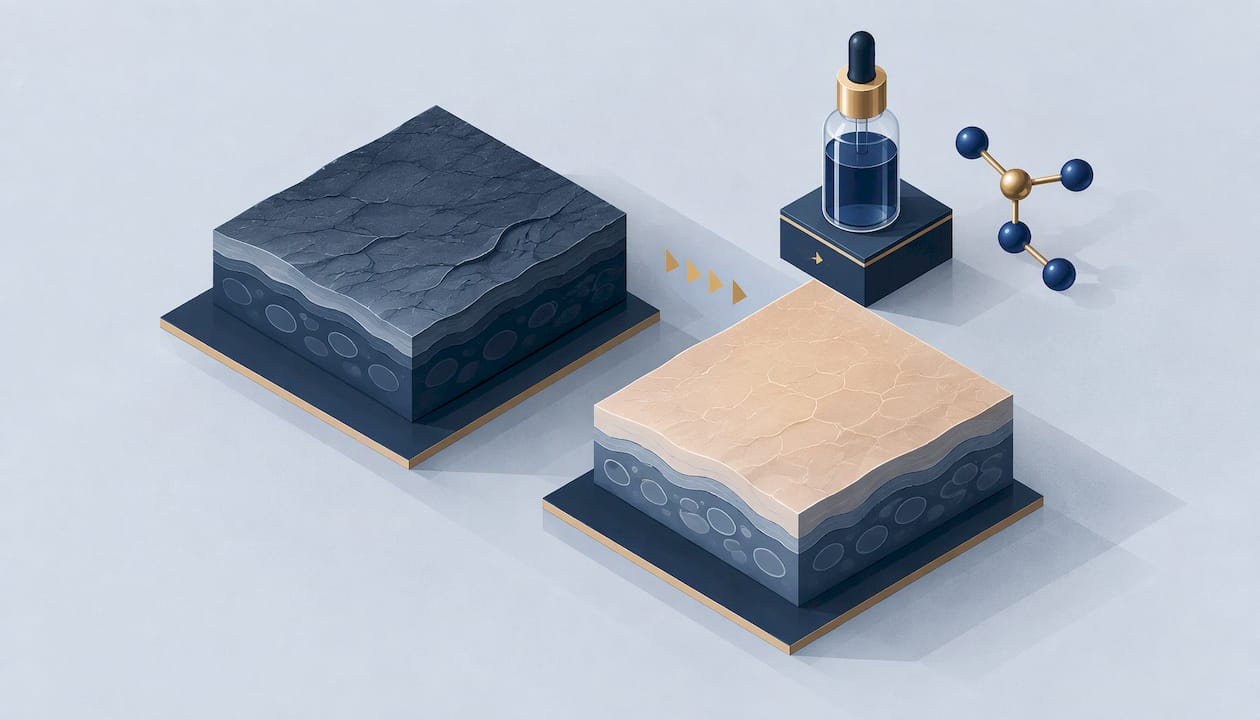
GHK-Cu before-and-after photos show mostly skin and hair changes, and the honest answer to “will I look like that?” depends on the formulation, the dose, how you use it and who is overseeing it. The studies that exist point to modest changes in skin texture, firmness and fine lines over weeks to months. A photo cannot tell you which product, which dose or which lighting produced the result. A physician can. At Strong Health, every peptide protocol is prescribed and monitored by a board-certified physician after an in-person or telehealth evaluation and baseline lab panels, so your own before-and-after is measured, not guessed.
TL;DR
- GHK-Cu (glycyl-L-histidyl-L-lysine copper) is a small copper-binding peptide. Placebo-controlled trials report improvements in fine lines, elasticity, thickness, firmness and collagen, in small studies (American Academy of Dermatology).
- Skin changes in social posts are often described as appearing over roughly 2 to 4 weeks at first, with firmer results taking longer. Treat any timeline as a range, not a promise.
- For scalp hair, no registered clinical trial of GHK-Cu exists yet, so no reliable before-and-after timeline has been established (systematic review, 2026).
- Product quality varies between manufacturers, and topical copper peptides can irritate, especially when layered with other actives.
- Photos are the weakest form of evidence. Baseline labs, measured follow-up and a physician’s dosing are what make your own results interpretable.
Table of Contents
- What GHK-Cu is and why people photograph it
- Before and after for skin: what people report
- How long does GHK-Cu take to show results?
- Hair photos and the minoxidil comparison
- How to read a before-and-after photo
- Using copper peptides safely
- What about sermorelin before and after?
- Build a before-and-after you can trust
- How Strong Health supports your plan
- FAQ
- Sources
What GHK-Cu is and why people photograph it
GHK-Cu is a short chain of three amino acids bound to a copper ion. It occurs naturally in the body and is now sold in serums, creams and injectable or compounded forms. The reason it fills social feeds is simple: skin and hair change in ways a camera can capture.
The American Academy of Dermatology notes that placebo-controlled trials have reported better fine lines and wrinkles, elasticity, thickness, firmness and collagen with copper peptides. It also says the evidence is still preliminary and made up of small trials, and that formulation quality, concentration and stability differ a lot between manufacturers (AAD, 2026).
That last point matters for any photo you see. Two people can both say “GHK-Cu” and be using different strengths, different delivery methods and different companion ingredients. For a deeper look at the compound, see our guide to GHK-Cu uses, evidence and safety.
Before and after for skin: what people report
The most consistent theme in posts and trials is skin quality: texture, redness, dullness, firmness and fine lines. A typical account from social media describes smoother, brighter skin after consistent topical use.
What the research supports, in plain terms:
- Firmness and elasticity. Small controlled trials reported gains, which is the finding most often behind the “skin tightening” claim.
- Fine lines. Trials reported fewer visible fine lines and wrinkles.
- Thickness and collagen. These were measured in some studies, which is why collagen shows up in nearly every explainer.
A 2026 commentary in Aesthetic Surgery Journal looked at a review of 20 studies, 18 of them preclinical and two randomized trials, with 52 people completing those trials. Its authors say this is a base for more research, not a basis for promising results to any one person (Aesthetic Surgery Journal, November 2026). The practical reading: expect gradual, subtle change, and judge it by consistent photos rather than a single dramatic comparison.
If skin is your main goal, our page on whether peptides work for skin covers the options side by side.
How long does GHK-Cu take to show results?
Social and blog timelines often cite early skin changes within 2 to 4 weeks, with more visible changes later. Those are anecdotes, not trial endpoints, and they depend on the product.
A more useful way to think about time:
| Goal | What the research says | What to expect |
|---|---|---|
| Skin texture and tone | Small placebo-controlled trials report benefits | Gradual change over weeks, judged with consistent photos |
| Fine lines and firmness | Reported in small trials | Longer horizon, usually months |
| Eyebrow hair | An 18-person split-face study reported positive cosmetic outcomes, but did not define the exact copper form or local exposure (review, 2026) | Too limited for a firm timeline |
| Scalp hair | No registered clinical trial of GHK-Cu for scalp hair loss (systematic review) | No established timeline |
The same review described a 13-person study after CO2 laser that found no clear objective advantage on its measures, which shows how much results depend on the setting and the endpoint chosen.
Hair photos and the minoxidil comparison
Many hair posts compare GHK-Cu with minoxidil. They are not the same kind of evidence. Large randomized trials show hair-count benefits from minoxidil in men and women. GHK-Cu has no established controlled scalp-hair trial, and the small human findings people cite involved either eyebrows or a copper-free GHK combined with another compound, so they do not transfer to a scalp (systematic review, 2026).
What shapes anyone’s hair result:
- The exact peptide and formulation, including whether copper is present.
- Scalp versus eyebrow, since studies measured different areas.
- Delivery method and dose.
- Type and location of hair loss.
- Individual response to minoxidil, which varies in part with an enzyme called SULT1A1 in the follicle. People with low activity are more likely to respond poorly (2025 efficacy review).
That last point is a good reason to have a physician look at your pattern of loss and your history before you commit to months of any routine. Our page on whether peptides regrow hair goes through the details.
How to read a before-and-after photo
A photo is a claim, not a measurement. Before you take one as a preview of your own result, check what it leaves out.
- Lighting and angle. Soft light, a tan, makeup, a different camera distance or a relaxed expression can mimic improvement.
- What else changed. People rarely use one product. Retinoids, sunscreen, sleep, weight changes and other actives all alter skin and hair.
- Time and consistency. Ask how long the gap was, and whether the “after” was taken in the same place and conditions.
- Which product. Strength, formulation and the source differ widely, as the dermatologists point out.
- Who is showing it. A single success story says little about the typical result.
The AAD’s own advice is that before-and-after claims should not lead people to give up evidence-based treatments such as retinoids, and that new products should be patch tested (AAD).
Using copper peptides safely
The known risk with topical copper peptides is skin irritation: redness, burning, irritation or dermatitis, particularly when they are layered with several active ingredients at once (AAD). A few habits reduce that risk:
- Patch test a new product on a small area before using it on your face.
- Introduce one active at a time so you can tell what causes a reaction.
- Stop and see a dermatologist or your physician if redness, burning or a rash persists.
- Tell your physician about every product and medication you use, including prescription skin treatments.
Injectable or compounded peptides call for a physician’s prescription and monitoring. That is not a formality. It is how dose, timing and your own lab values are matched to your goal.
What about sermorelin before and after?
Sermorelin is a different peptide, one that signals the pituitary gland to release growth hormone. People searching for it usually want body composition, sleep or energy changes rather than skin changes, and photos are a poor way to capture those.
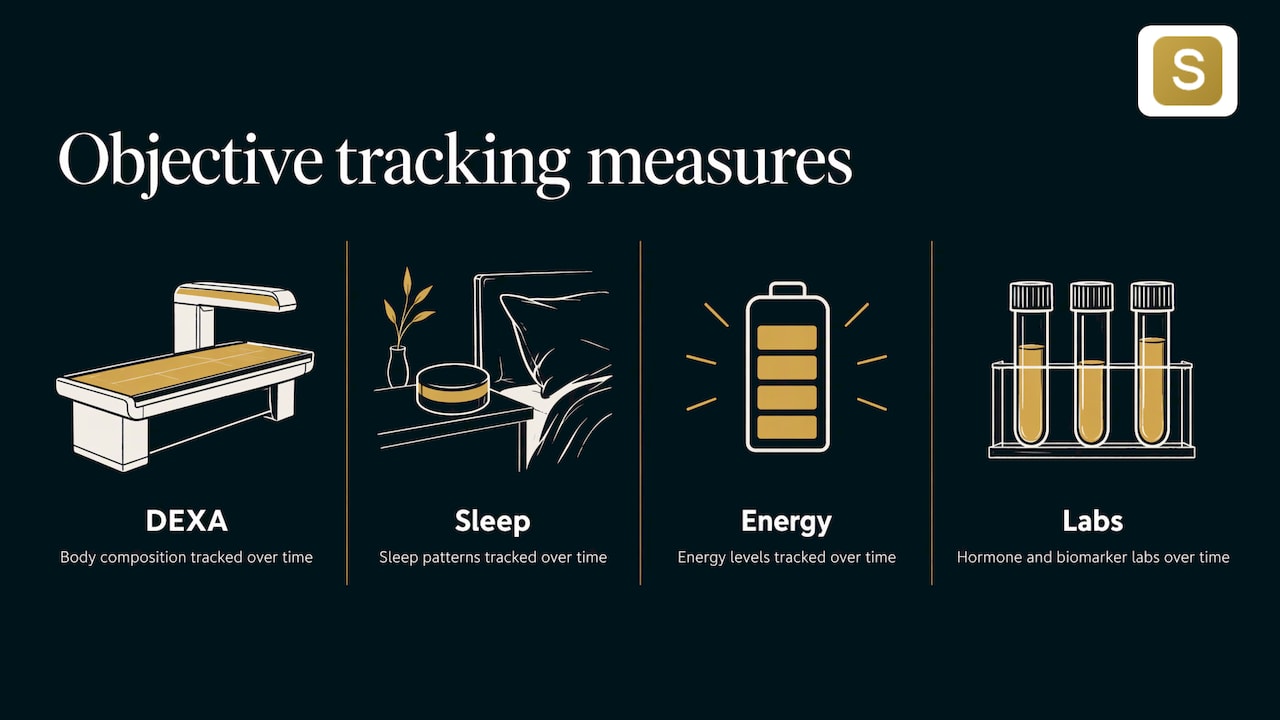
The measures that actually track those goals are objective ones: body composition on a DEXA scan, sleep patterns, energy levels and hormone and biomarker labs, repeated over time. That is how a before-and-after becomes meaningful. If body composition is your goal, our guide to peptides for muscle growth lays out the human evidence, and the peptides for men and peptides for women pages cover the differences by sex.
Build a before-and-after you can trust
The most useful before-and-after is your own, measured the same way at each point. A sound approach looks like this:
- Start with a medical evaluation. A board-certified physician reviews your goal, history and medications, in person or by telehealth.
- Get baseline labs. Comprehensive biomarker panels before any prescription give you a true “before” that a photo cannot.
- Choose the goal first, the peptide second. Healing, weight, muscle, sleep and libido each point to different options.
- Standardize your photos. Same light, same angle, same distance, same time of day, every two to four weeks.
- Follow up and adjust. Dose and plan change as markers change, which is why ongoing monitoring matters more than any single product.
- Measure what the camera cannot. For body composition, a DEXA scan before and after shows fat and lean mass directly.
How Strong Health supports your plan
Strong Health provides physician-supervised peptide therapy for specific goals, including healing and recovery, muscle growth, weight and belly fat, sleep, and libido. Every treatment is prescribed and monitored by a board-certified physician, begins with an in-person or telehealth evaluation and comprehensive biomarker labs, uses pharmacy-grade peptides, and continues with follow-up and dosage adjustments. Our approach combines telehealth follow-ups with in-person assessments, and our protocols are built to be transparent and evidence-based, without marketing hype.

If you want a plan built around your own labs and goals, start with physician-supervised peptide therapy. If body composition is how you want to track progress, our diagnostics include DEXA scans, hormone testing, VO2 max and resting metabolic rate testing.
FAQ
Does GHK-Cu really work for skin?
Small placebo-controlled trials have reported improvements in fine lines, elasticity, thickness, firmness and collagen. The studies are small, and results depend on the formulation and concentration. A physician or dermatologist can help you choose a sensible routine and track it.
How long does GHK-Cu take to work?
There is no single trial-proven timeline. Posts commonly describe early skin changes in the first few weeks, with firmer results later. For scalp hair, no registered clinical trial exists, so no timeline has been established.
Is GHK-Cu better than minoxidil for hair growth?
They are not supported by the same level of evidence. Minoxidil has large randomized trials showing hair-count benefits, while no head-to-head trial has compared the two. A physician can review your type of hair loss and help you decide what fits.
Can GHK-Cu irritate my skin?
Yes, topical copper peptides can cause redness, burning, irritation or dermatitis, especially when combined with several active ingredients. Patch test first, add one product at a time, and stop and see your physician or a dermatologist if irritation persists.
What should I look for in sermorelin before-and-after results?
Look for measured changes rather than photos: body composition on a DEXA scan, sleep and energy tracking and lab values over time. These show whether a plan is working for you specifically.
Sources
- [1]Copper peptides, American Academy of Dermatology
- [2]GHK-Cu as a Bioactive Metallopeptide and Drug-Delivery review, PubMed Central
- [3]A Systematic Review of the Mechanisms and Therapeutic Potential of GHK-Cu, PubMed Central
- [4]Mechanistic Plausibility Should not be Conflated With Clinical Validation, Aesthetic Surgery Journal
- [5]Relative Efficacy of Conventional Monotherapies and Select Therapies for Androgenetic Alopecia, PubMed Central
Recommended
This content is for informational purposes only and does not constitute medical advice, diagnosis, or treatment. Always seek the advice of your physician or other qualified health provider with any questions you may have regarding a medical condition. Never disregard professional medical advice or delay in seeking it because of something you have read on this website. Authorship and review information are shown where recorded; an editorial update is not a new medical review.
More Health Guides
Looking for care? View Strong Health locations and visit options.
Get Your Free Assessment
Take our 5-minute assessment to see if testosterone therapy may be right for you. Reviewed by a licensed physician within 24 hours.
Start Free Assessment