Longevity Peptides: What They Are and How to Use Them Safely
What longevity peptides are, what the human evidence shows, the risks of unsupervised use, and how physician-supervised peptide therapy works with labs.

Longevity peptides are short chains of amino acids promoted for tissue repair, muscle, sleep, metabolism and healthy aging. The safest way to approach them is with a board-certified physician who runs baseline labs first, prescribes pharmacy-grade products and tracks your biomarkers over time. That is how we do it at Strong Health, and it is the approach this guide explains.
The topic is crowded with hype, and the public science is still catching up. Below you will find what the major medical institutions say, which peptides come up most, what the risks are, and what a supervised protocol looks like.
TL;DR
- “Longevity peptide” is a marketing label, not a drug class. Peptides are short amino-acid chains, and the ones promoted for longevity are mostly not FDA-approved for that purpose.
- Most of the research on popular compounds such as BPC-157, TB-500, GHK-Cu and epitalon is in animals or in small human studies. No large trial has shown that any of them extends lifespan.
- Known risks include injection-site irritation, nausea, headache, and uncertainty about the source and purity of products bought outside medical channels.
- Physician supervision means a baseline lab panel, a prescribed product from a pharmacy, and follow-up to adjust or stop treatment based on your numbers.
- Pick a concrete goal (recovery, muscle, sleep, weight, hormones) and build the plan around it.
Table of Contents
- What longevity peptides actually are
- Which peptides come up most often
- What the research says today
- Are longevity peptides FDA-approved?
- Risks to know before you start
- What a physician-supervised protocol looks like
- Matching the goal to the plan
- How to tell a legitimate program from a risky one
- Starting with Strong Health
- What to expect over the long term
- FAQ
- Sources
What longevity peptides actually are
Peptides are short chains of amino acids, the building blocks of proteins. Your body makes thousands of them, and many act as signals between cells. Stanford Medicine notes that peptide medicines include established, approved drugs, while many peptides sold in the gray market have not been tested in humans or made in a regulated process.
The phrase “longevity peptides” groups together very different compounds. According to the AAMC’s July 2026 guide, they are promoted for tissue repair, muscle building, cognition, inflammation control and a longer life. The same guide is clear that marketing claims are not evidence of benefit.
That distinction shapes everything that follows. A peptide’s name tells you little. What matters is which compound it is, where it came from, what human data exists, and who is watching your response.
Which peptides come up most often
The AAMC lists BPC-157, TB-500, GHK-Cu and KPV among the compounds commonly promoted for repair, recovery, inflammation or longevity, often in combinations called “stacks.” Here is a plain-language summary of the names you will see:
| Peptide | What it is promoted for | Where the evidence stands |
|---|---|---|
| BPC-157 | Tissue and tendon repair, gut health | The review the AAMC cites found three small pilot studies in humans |
| TB-500 | Recovery, inflammation | Described mostly through animal research |
| GHK-Cu | Skin, tissue repair, anti-aging | Promoted for repair and longevity; see our GHK-Cu guide |
| KPV | Inflammation | Promoted for inflammation control |
| Epitalon | Aging biomarkers | A 2026 review found small biomarker studies and no adequately powered randomized trial on longevity |
| Growth hormone secretagogues | Muscle, sleep, body composition | Studied for specific endpoints; see below |
If you want a deeper look at one compound, our pages on BPC-157 and on peptides for anti-aging go through uses, evidence and safety.
What the research says today
The research on peptides is active and moving quickly, and it helps to read it accurately.
The AAMC says there is very little human data showing benefit from unapproved peptides, and that the regenerative effects people cite come from animal studies. A 2026 UCLA review of 565 studies across six compounds found that more than two-thirds were animal studies. It also reported that the human studies showed at most modest benefits outside orthopedic conditions, and were often poorly controlled or designed.
On epitalon specifically, a 2026 narrative review describes human evidence as small physiological or biomarker studies plus an older retinal study with design limitations. It found no adequately powered randomized trial on longevity.
What does this mean for you? Two practical things:
- Longevity is a long game with no short-term scoreboard. Nobody can show you in 12 weeks that a compound has added years. What you can measure are specific, trackable goals: recovery from an injury, lean mass, sleep quality, body composition, hormone levels, inflammatory markers.
- Your own data matters more than a headline. A plan built on your labs and reviewed at regular intervals tells you what is happening in your body, not what happened in a mouse.
That is why we organize care around a defined health goal instead of selling an open-ended “longevity stack.”
Are longevity peptides FDA-approved?
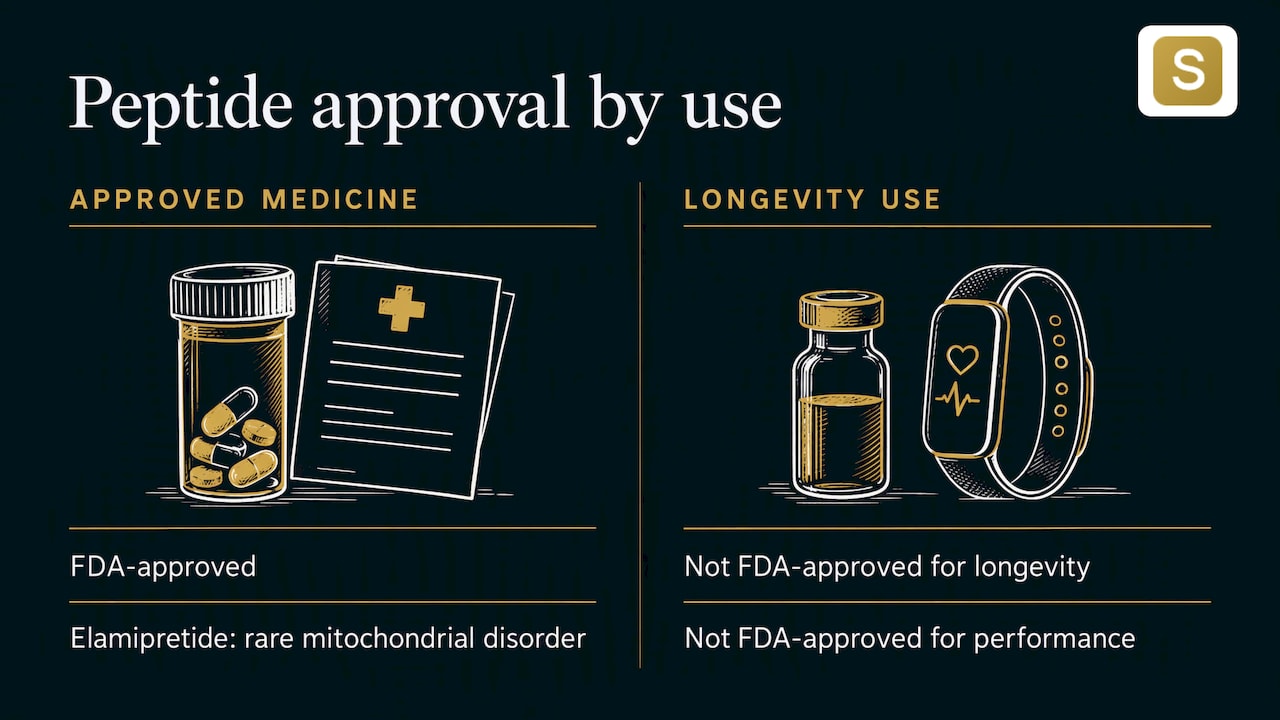
Peptides as a class are not unapproved. Many approved medicines are peptides. The AAMC points to elamipretide, approved for a rare genetic mitochondrial disorder, as an example. But it also states that peptides marketed for longevity or performance have not been FDA-approved for those uses.
What does that mean in practice? A licensed physician can evaluate whether a given therapy is appropriate for you, and a licensed pharmacy compounds or dispenses it. Products sold online as “for research use only” are outside that system. Our guide on whether peptides are FDA approved covers the regulatory picture in more detail.
Risks to know before you start
This is the part to read slowly, because it affects how you should go about getting any peptide.
Common side effects. The reported effects include injection-site irritation, nausea, vomiting and headache, along with open questions about longer-term effects and about where products come from, according to the Stanford Medicine overview.
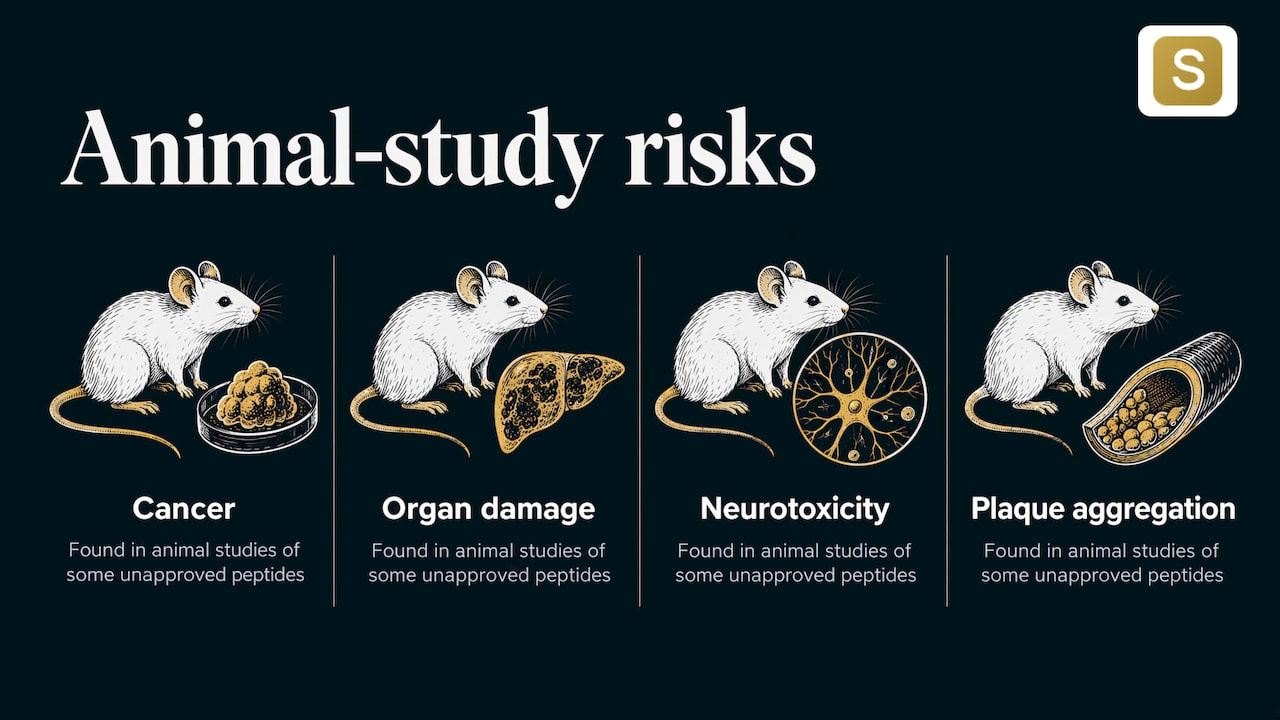
Findings from animal studies. Stanford Medicine also notes that animal studies of some unapproved peptides have found cancer, organ damage, neurotoxicity and plaque aggregation. That is one reason compound selection and monitoring matter.
Growth hormone pathway compounds. UCLA’s report describes a trial of the compound MK-677 that was stopped after a higher rate of congestive heart failure in one group. The report cautions that a clinical case it described did not establish causation. Anyone with heart, kidney or liver conditions, a history of cancer, or who is pregnant or breastfeeding should tell their physician before any peptide is considered, and should not start one without a medical evaluation.
Product quality. If you cannot verify who made a vial, what is in it or how it was handled, you cannot know what you are injecting. This is the single biggest practical reason to go through a prescribing physician and a pharmacy.
What a physician-supervised protocol looks like
Supervision is not a formality. It is the structure that keeps the process safe and keeps the plan tied to your numbers. At Strong Health, every treatment is prescribed and monitored by a board-certified physician, and the process runs in these stages:
- Evaluation. You complete an in-person or telehealth evaluation. The physician reviews your history, medications, goals and symptoms. This is where conditions that rule out a peptide, or call for a different approach, are caught.
- Baseline labs. We run comprehensive biomarker panels before anything is prescribed. These give the physician a starting point and flag issues such as hormone imbalances that may be driving your symptoms.
- Individualized plan. The physician selects the peptide that fits your goal, whether healing, muscle growth, weight, sleep, libido or hormonal balance, and the dose. We use pharmacy-grade peptides.
- Follow-up. Telehealth check-ins and in-person assessments allow dose adjustments and ongoing biomarker monitoring.
- Review. The results are compared against your baseline, so you and the physician can decide whether to continue, change or stop.
Baseline testing can also draw on diagnostics such as DEXA body composition scans, VO2 max testing, resting metabolic rate testing and hormone testing, all listed on our diagnostics page. These are the measures that turn “longevity” from a slogan into numbers you can track year over year.
Matching the goal to the plan
The people who get the most from a supervised protocol arrive with a specific objective. Here is how the common ones map to our pages:
- Healing and recovery. Soft-tissue and tendon problems are among the most common reasons people ask about peptides. Our guides on healing peptides and tendon repair peptides explain the evidence and the risks.
- Muscle growth. Lean mass is a long-term marker of healthy aging. See peptides for muscle growth for the human evidence.
- Weight and belly fat. Our weight loss guide explains the clinical options and how a physician decides among them.
- Sleep. Sleep is one of the best-studied drivers of how you age. Our sleep peptide guide covers options and risks.
- Men and women. Hormonal needs differ, so see our pages on peptides for men and peptides for women.
A worked example: a 48-year-old who wants to keep training despite a nagging tendon injury and poor sleep would start with an evaluation and labs, not with a stack. The physician might look at hormone levels, inflammation markers and body composition, choose one targeted approach for recovery, and schedule a follow-up to compare the numbers. Each change is made one at a time, so you can tell what is helping.
How to tell a legitimate program from a risky one
Some simple points separate medical care from a storefront:
- A physician evaluates you before anything is prescribed, in person or by telehealth.
- Labs come first, and they are repeated.
- The product is pharmacy-grade and prescribed to you, not sold as a “research compound.”
- Claims are measured. A program that promises to reverse aging is selling hope, not medicine.
- Follow-up is built in, with room to change the dose or stop.
Those are the standards we hold ourselves to: transparent, evidence-based protocols without marketing hype or unsubstantiated claims.
Starting with Strong Health
If you want peptide therapy aimed at a specific goal, our physicians begin with an evaluation and a baseline lab panel, then build an individualized plan with ongoing monitoring. Our offerings include peptides for healing and recovery, muscle growth, weight and belly fat, sleep, and libido and sex drive, with in-person and telehealth visits. You can see the full list on our peptide therapy page or learn how physician-supervised peptide therapy works from first visit to follow-up.

We also publish a library of peptide therapy guides if you want to read more before booking.
What to expect over the long term
Healthy aging comes mostly from the basics: strength training, sleep, nutrition, cardiovascular fitness and managing metabolic and hormone health. Peptide therapy, when a physician judges it appropriate, is one tool that sits on top of that foundation, and your labs show how you are responding.
Expect a plan measured in months, with check-ins and repeat testing. Expect your physician to adjust or stop treatment based on your results. And expect the science to keep changing: the 2026 reviews above show how quickly new analyses are arriving, which is a good reason to have a physician following your case.
FAQ
What is the best peptide for longevity?
No peptide has been shown in large human trials to extend lifespan, so there is no single best one. The right choice depends on your goal, labs and history, and a physician should make it. We start with a defined target such as recovery, muscle, sleep or hormonal balance.
Are longevity peptides legit?
Peptides are real molecules, and some are approved medicines. The “longevity” claims attached to many of them rest largely on animal studies and small human studies, according to the AAMC and UCLA reviews. Getting them through a physician and a pharmacy is what makes the process legitimate.
Is there a downside to taking peptides?
Reported effects include injection-site irritation, nausea, vomiting and headache, and some animal studies raised additional concerns. Product quality is a major issue outside medical channels. Baseline labs, a prescribed pharmacy-grade product and follow-up are how we manage safety.
Who should avoid peptide therapy?
People who are pregnant or breastfeeding, have a history of cancer, or have heart, kidney or liver disease need a physician’s evaluation before any peptide is considered. Tell your physician about all medications and supplements you take.
Sources
Recommended
This content is for informational purposes only and does not constitute medical advice, diagnosis, or treatment. Always seek the advice of your physician or other qualified health provider with any questions you may have regarding a medical condition. Never disregard professional medical advice or delay in seeking it because of something you have read on this website. Authorship and review information are shown where recorded; an editorial update is not a new medical review.
More Health Guides
Looking for care? View Strong Health locations and visit options.
Get Your Free Assessment
Take our 5-minute assessment to see if testosterone therapy may be right for you. Reviewed by a licensed physician within 24 hours.
Start Free Assessment