Post-Surgery Recovery: Timeline, Care and Warning Signs
A practical guide to post-surgery recovery: realistic timelines, pain control, food, movement, warning signs, and how to plan healing support with a physician.

Most people feel back to normal activity within 1 to 3 weeks of a routine operation, but the tissue under the skin takes far longer to heal, and what you do in those first weeks decides how smooth the road is. Recovery goes best with a plan: pain control that stays ahead of the pain, early walking, enough protein and fluids, a clear list of warning signs, and a physician who knows your whole health picture. Below is what the major US medical bodies recommend, and how to think about extra healing support once your surgeon has cleared you.
TL;DR
- Expect roughly 1 to 3 weeks to return comfortably to daily activity, and 4 to 6 weeks before lifting more than 10 pounds or doing strenuous exercise.
- Take pain medicine before pain gets severe, walk early, drink water and eat protein and fiber.
- Call your surgeon for fever, worsening pain, wound redness, drainage or opening, or persistent vomiting. Call 911 for trouble breathing.
- Tell your surgeon about every injectable, supplement or peptide you use, before and after the operation.
- Once you are cleared, a physician-supervised plan with baseline labs is the safest way to add healing or training support.
Table of Contents
- What a realistic recovery timeline looks like
- The first 48 hours at home
- Pain control that actually helps you heal
- Move early, breathe deeply
- Food and fluids: the building blocks of healing
- Normal symptoms and warning signs
- Where peptides fit, and where they do not
- How Strong Health supports recovery once you are cleared
- Recovering from intense workouts
- A six-week checklist
- FAQ
- Sources
What a realistic recovery timeline looks like
The American College of Surgeons says patients usually need 1 to 3 weeks to return comfortably to normal activity. It discourages lifting over 10 pounds or strenuous activity for at least 4 to 6 weeks.
A transplant surgeon at University of Utah Health explains why the numbers run longer than they feel. Skin can look healed within days, but the muscle and fascia (the tough connective layer around muscle) underneath take much longer. Put too much tension on that deeper tissue and it can stretch into a thin, weak layer that eventually becomes a hernia at the incision. The same source says most people are out of their normal routine for at least a week after standard elective surgery, and that “heavy” starts at about 10 pounds, roughly a full gallon jug plus a bag of groceries.
Wound strength builds slowly. U.S. News, citing surgeons, puts it at minimal in week one, around 30% to 50% by four to six weeks, and about 60% near six months. So feeling good at week three does not mean the repair is finished.
Two things set your personal pace:
- The type of surgery. A laparoscopic procedure and an open abdominal or joint operation are not on the same schedule.
- How healthy you were going in. Baseline fitness, nutrition and chronic conditions all matter, which is why preparation before surgery counts as much as care afterward.
The first 48 hours at home
Anesthesia and pain medicine can leave you feeling off, forgetful or tired for 2 to 3 days. The American College of Surgeons advises no driving, no alcohol and no big decisions for at least two days. A University of Chicago orthopedic surgery page adds that you should not be alone and should not sign legal documents in the first 24 hours, because of the sedatives still in your system.
Set up before you leave the hospital or surgery center:
- Have someone stay with you the first night.
- Put water, medicine, phone and snacks within arm’s reach of where you will rest.
- Clear walkways so your first trips to the bathroom are safe.
- Write down your surgeon’s after-hours number and keep it on the fridge.
Pain control that actually helps you heal
Pain management is not just about comfort. Cleveland Clinic notes that well-controlled pain makes it easier to walk, move and breathe deeply, which lowers the risk of complications such as pneumonia and blood clots.
Practical rules from the Veterans Affairs discharge guidance:
- Take pain medicine before the pain becomes severe. Most oral pain relievers need 20 to 30 minutes to work.
- Never mix alcohol with pain medicine. It can cause dizziness and slow breathing, and can be deadly.
Cleveland Clinic suggests timing doses before activity or at bedtime and pairing medicine with non-drug methods such as breathing exercises, heat or cold. It also lists the common side effects to watch for: nausea, drowsiness, dizziness, itching, internal bleeding and liver damage. It warns that opioids can be habit-forming and cause fatal overdose. Take exactly the dose your surgeon prescribed, and ask the pharmacist whether anything you already take interacts with it.
Move early, breathe deeply
It feels backwards, but getting up helps. The American Cancer Society says walking soon after surgery gets the digestive tract moving, improves circulation and helps prevent blood clots and pneumonia. Deep-breathing exercises, or an incentive spirometer (the plastic breathing device many hospitals send home), lower the pneumonia risk.
A simple progression:
- Days 1 to 3: short walks around the house every hour or two while awake, plus deep breaths on a schedule.
- Week 1 to 2: longer walks on flat ground, as pain allows.
- Weeks 2 to 6: gradually add normal daily tasks, keeping the 10-pound limit unless your surgeon sets a different one.
Swimming and baths wait until the wound is completely closed. Ask your surgeon when you can start exercising again and which restrictions apply to your specific procedure, since MedlinePlus lists exactly that as a question to settle before you leave.
Food and fluids: the building blocks of healing
Healing runs on raw material. University of Utah Health points out that proteins and vitamins are the building blocks, so a balanced diet matters after surgery.
Following the VA guidance, move from clear liquids to soft foods to solid foods, in smaller, more frequent meals if your stomach is unsettled. The American College of Surgeons recommends about 8 to 10 glasses of water a day and a high-fiber diet of beans, whole grains, fruits, vegetables and nuts, so you do not strain during bowel movements. Straining is a real concern after abdominal and pelvic surgery, and constipation from pain medicine makes it worse.
A sample day that works for most people:
| Meal | What to aim for |
|---|---|
| Breakfast | Eggs or Greek yogurt, oatmeal, fruit |
| Mid-morning | Smoothie or cottage cheese, a glass of water |
| Lunch | Chicken, fish or beans with vegetables and whole grains |
| Afternoon | Nuts or hummus with whole-grain crackers |
| Dinner | Lean protein, cooked vegetables, a starch |
Your surgeon or dietitian may set a different plan for specific operations, such as bariatric surgery. Follow theirs first.
Normal symptoms and warning signs
MedlinePlus says some pain, swelling and soreness around the surgical area are expected after any operation. Complications can include infection, too much bleeding, a reaction to anesthesia or accidental injury.
Call your surgeon if you have:
- Pain that will not go away or keeps getting worse, even with medicine
- Fever over 101°F (38.3°C) per the American College of Surgeons, or 100.4°F (38°C) or higher per the VA guidance
- Continuous vomiting
- Redness, swelling, bleeding or bad-smelling drainage at the wound
- An incision that looks different or opens up
- Strong abdominal pain or swelling, or no bowel movement 2 to 3 days after surgery
- Rash or hives, or excessive sleepiness or dizziness
Call 911 for trouble breathing, facial swelling, chest pain or heavy bleeding.
Is a low fever normal?
A University of Chicago post-operative page says a low-grade fever is typical right after surgery, but it tells patients to call the surgical team for a fever above 101.5°F. Because instructions differ by surgeon, use the number on your own discharge paperwork. If you have no number, call the office when you cross 100.4°F rather than waiting.
The post-surgical blues and anxiety
Feeling low, tearful or anxious in the weeks after surgery is common, in part because of pain, poor sleep and being cut off from your routine. Tell your surgeon or primary care physician if it lingers or deepens. Daily walks, daylight, regular meals and short visits with people you like all help.
Where peptides fit, and where they do not
If you are reading this, you may also be wondering whether peptide therapy can speed healing. It is a fair question, and the honest answer is about timing and supervision.
The research here is early. A 2026 scoping review in the Journal of Orthopaedic Experience & Innovation found the evidence on BPC-157 and TB-500 is mostly preclinical, with limited human data and no high-quality studies on surgical outcomes. Neither is FDA-approved for orthopaedic use. The authors recommend a conservative approach around surgery, including holding unregulated injectables before the operation.
The American Medical Association reports that many commercially sold peptides are labeled “not for human consumption” because they are research products that have not been through clinical trials, with possible contaminants in vials. It stresses that anyone considering peptides should talk to a doctor first, and that side effects such as headaches, nausea and digestive problems, and occasionally pancreatitis or gallbladder issues, need monitoring by a physician.
What that means in practice:
- Before surgery: tell your surgeon and anesthesiologist about every peptide, injectable and supplement. Follow their instructions about stopping anything before the operation.
- Right after surgery: your job is wound care, pain control, movement and nutrition. Do not start anything new without your surgeon’s approval.
- After you are cleared: a physician can evaluate whether healing or recovery support makes sense for your goals, using your own lab data rather than guesswork.
For a closer look at the human evidence, our guides on healing peptides, recovery peptides and tendon repair peptides lay out what is known and what the risks are.
How Strong Health supports recovery once you are cleared
Once your surgeon says you can resume normal activity, the next question is how to rebuild: muscle, sleep, hormonal balance and energy. At Strong Health, every treatment is prescribed and monitored by a board-certified physician. Care starts with an in-person or telehealth evaluation and comprehensive baseline biomarker lab panels before anything is prescribed. Peptides are pharmacy-grade, and follow-up visits, by telehealth or in person, allow dosage adjustments and ongoing monitoring.

If you want a physician-supervised plan built around your own labs and goals, including healing and recovery, muscle growth or sleep, see our peptide therapy programs or start at Strong Health.
Recovering from intense workouts
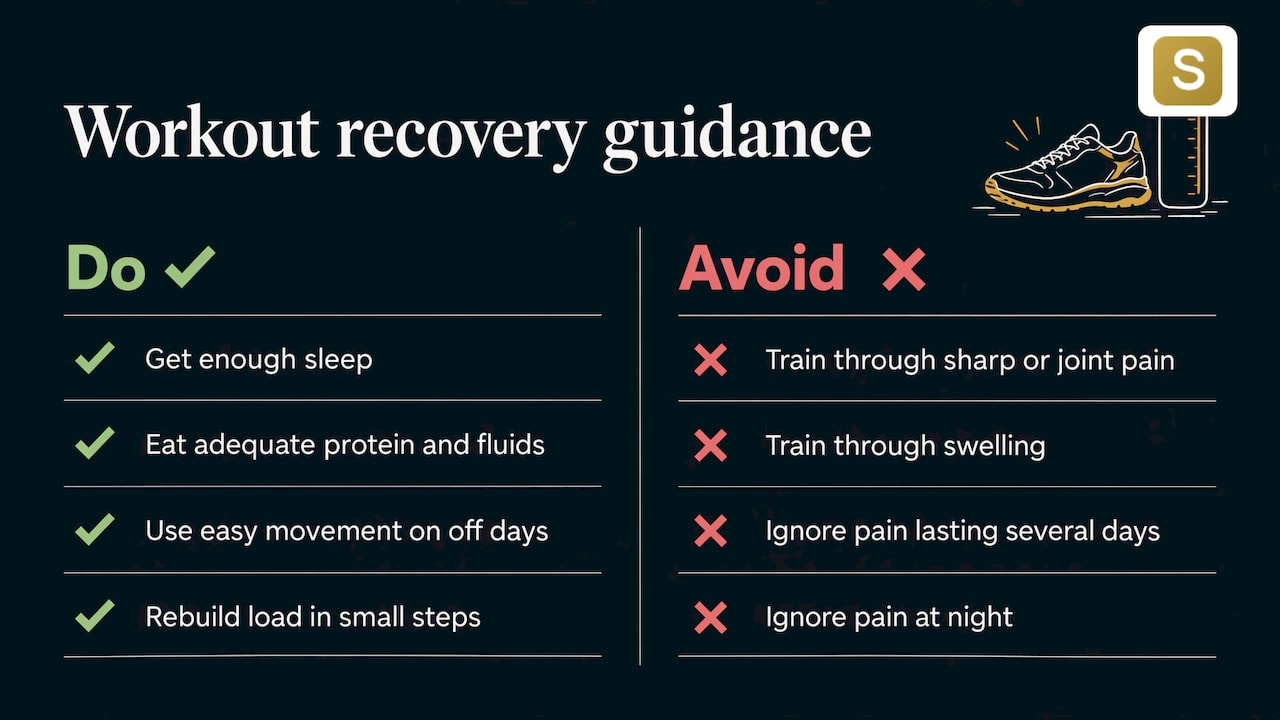
The same logic that applies to surgery applies on a smaller scale to hard training: the stimulus happens in the gym, but the adaptation happens afterward. Good recovery rests on the same basics as above: enough sleep, adequate protein and fluids, easy movement on off days and a gradual build back up after any layoff.
The rules change when pain is the issue rather than ordinary soreness. Sharp or joint-centered pain, swelling, pain that lasts well beyond several days or pain at night calls for a medical evaluation rather than more training. If you are returning to the gym after surgery, treat your surgeon’s restrictions as the ceiling, not a suggestion, and rebuild load in small steps.
For readers whose goal is muscle gain on top of good recovery habits, our guide to peptides for muscle growth covers the human evidence, and our diagnostics page lists testing such as DEXA scans, hormone testing and VO2 max testing that can show where you are starting from.
A six-week checklist
- Before surgery: list your medicines, supplements and injectables for the surgical team, and arrange rides and help at home.
- Days 1 to 2: rest, no driving, no alcohol, no major decisions, medicine on schedule.
- Week 1: walk often, breathe deeply, eat protein, drink water, watch the wound daily.
- Weeks 2 to 3: most people are back to light daily activity, with no lifting over 10 pounds.
- Weeks 4 to 6: follow-up visit, ask for activity clearance, and build back gradually.
- After clearance: discuss your goals with a physician, and let labs guide any added support.
FAQ
How long does post-surgery recovery take?
Most people return comfortably to normal activity in 1 to 3 weeks, according to the American College of Surgeons, but lifting over 10 pounds and strenuous activity are discouraged for at least 4 to 6 weeks. Deeper tissue keeps healing well after the skin looks fine. Your procedure and your health beforehand set the exact pace.
Is a low fever normal after surgery?
A low-grade fever can be typical right after an operation. Contact your surgical team at the threshold on your discharge sheet, commonly 100.4°F (38°C) per VA guidance or above 101.5°F per one university surgical practice. Fever with redness, drainage or worsening pain is a reason to call the same day.
Should I walk after surgery or rest?
Both. Rest enough to manage pain and fatigue, but walk short distances early and often. Early movement improves circulation and helps prevent blood clots and pneumonia, according to the American Cancer Society.
Can I take peptides while recovering from surgery?
Tell your surgeon about any peptide before surgery and do not begin one afterward without their approval. Research on peptides around surgery is still early, and unregulated products carry sourcing risks, so any use should go through a physician who can review your labs and your surgical plan.
Sources
- [1]Recovering from Surgery, American College of Surgeons
- [2]What to Expect When Recovering from Surgery, University of Utah Health
- [3]Pain Medications After Surgery, Cleveland Clinic
- [4]Discharge Instructions: After Your Surgery, Veterans Health Library
- [5]Recovering from Cancer Surgery, American Cancer Society
- [6]After Surgery, MedlinePlus
- [7]Emerging Peptide Therapies in Orthopaedics, Journal of Orthopaedic Experience & Innovation
- [8]8 things patients should know about peptides, American Medical Association
Recommended
This content is for informational purposes only and does not constitute medical advice, diagnosis, or treatment. Always seek the advice of your physician or other qualified health provider with any questions you may have regarding a medical condition. Never disregard professional medical advice or delay in seeking it because of something you have read on this website. Authorship and review information are shown where recorded; an editorial update is not a new medical review.
More Health Guides
Looking for care? View Strong Health locations and visit options.
Get Your Free Assessment
Take our 5-minute assessment to see if testosterone therapy may be right for you. Reviewed by a licensed physician within 24 hours.
Start Free Assessment